
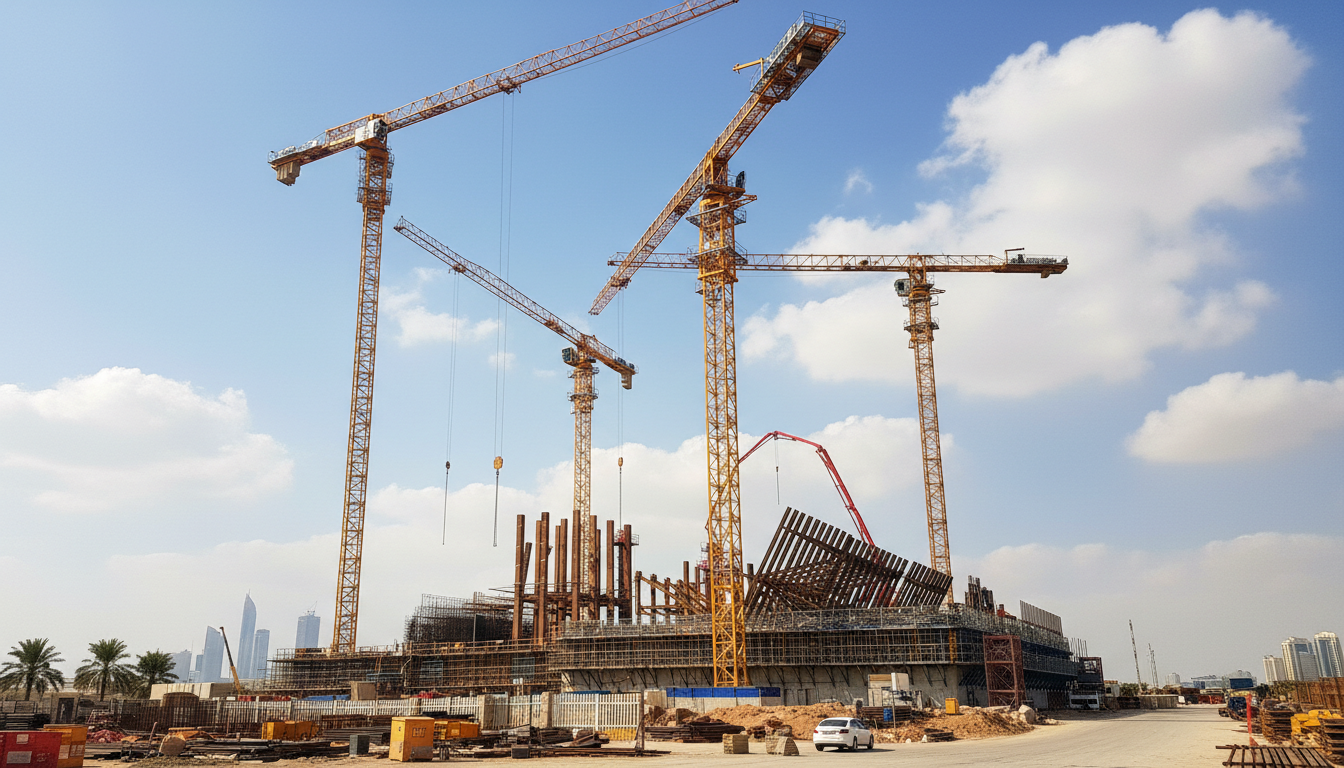
The HUBA H-Series is not just a product line — it is over 20 years of continuous engineering refinement focused on one goal: giving construction teams a crane that performs reliably, safely, and efficiently on the most demanding high-rise sites in the world.
When HUBA Middle East decided to bring tower crane solutions to the UAE market, the choice of manufacturer was deliberate. The HUBA H-Series represents a range that has been refined through real-world deployment on high-rise construction projects across Asia and the Middle East — environments that demand exceptional structural integrity, reliable drive systems, and practical maintainability.
In this article, we go inside the engineering of the HUBA H-Series to explain what makes it well-suited for high-rise construction projects across Dubai and the UAE.
The HUBA H-Series has been continuously developed and refined for over two decades. The result is a structural design philosophy that prioritises long-term fatigue life, weld quality, and steel section selection over short-term weight reduction. For contractors, this translates directly into fewer structural issues over the life of the crane on site and a more predictable maintenance profile.
The mast sections of the H-Series are engineered with conservative safety factors on all primary structural members — a design choice that adds slightly to the crane's self-weight but significantly extends the structural service life, particularly important for projects where the crane will be in operation for 18 months or more.
One of the defining features of the HUBA H-Series is the integration of Variable Frequency Drive (VFD) technology across the hoisting, slewing, and trolley travel mechanisms. VFD technology provides smooth, stepless speed control — eliminating the shock loads associated with older contactor-switched drive systems.
For UAE contractors, the practical benefits of VFD technology on site are significant:
The H-Series incorporates a comprehensive suite of electronic safety systems as standard equipment. The load moment indicator (LMI) continuously monitors hook load against the crane's rated capacity at the current operating radius, providing the operator with real-time feedback and triggering automatic cutout before any overload condition can occur.
Additional safety systems fitted as standard include:
UAE Compliance Note: The H-Series standard safety system specification meets the requirements of Dubai Municipality and other UAE municipal authorities for crane erection permits, providing contractors with straightforward compliance documentation.
A crane that is difficult to maintain will always cost more to operate over the life of a project. The H-Series is designed with practical field maintenance in mind — key wearing components are accessible without specialist tooling, standard replacement parts are kept in stock by HUBA Middle East in the UAE, and service intervals are designed around the realities of busy construction site schedules.
The electrical control systems use modular components that can be swapped in the field without specialist programming equipment — minimising downtime in the event of an electrical fault. For UAE contractors working on time-critical high-rise projects, this practical approach to maintainability is a significant operational advantage.
HUBA Middle East offers over 17 certified H-Series crane models, covering a comprehensive range of load capacities and jib configurations suitable for residential, commercial, and infrastructure projects across the UAE. From compact H-Series models suited to mid-rise residential construction to large-capacity configurations for major commercial towers, we can match the right crane to your project requirements.
Our technical team will review your project specifications and recommend the most appropriate H-Series model — with full documentation for UAE municipal approval included as standard.
View all 17+ HUBA H-Series crane models available through HUBA Middle East — with full technical specifications.
View Our Products